
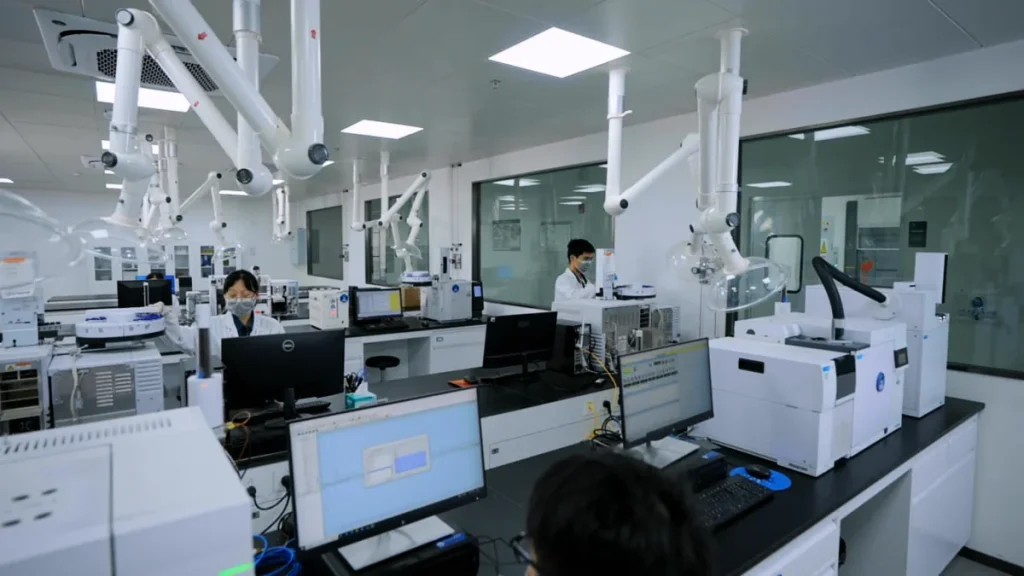
Compositional Analysis Services
Determine what a material contains, compare compositions and investigate unexpected components. Anysis combines complementary analytical approaches to support elemental, molecular, bulk, surface and trace composition questions.
Understand What Is Present—and Why It Matters
Compositional analysis examines the chemical or elemental makeup of a material. It can be used to identify major and minor components, confirm expected ingredients, quantify selected constituents, compare similar samples and investigate unexpected substances.
Because “composition” can refer to different information depths and chemical classes, method selection should begin with the question: do you need bulk elemental composition, molecular or organic information, trace impurities, a thin layer, or the chemistry at a surface?
Questions This Service Can Help Answer
- What elements, compounds or material classes are present?
- How do two suppliers, grades or production batches differ?
- Are unexpected additives, residues or foreign components present?
- Is the information needed from the bulk, a surface, a coating or a thin layer?
Compositional Analysis Capabilities
Different analytical approaches answer different composition questions. A project may use one technique or a coordinated combination of methods.
Bulk Composition
Evaluate major and minor components representative of the overall material.
- Major/minor elements
- Organic or polymer composition
- Comparative composition
Trace Elemental Analysis
Investigate low-level elemental impurities that may influence quality or performance.
- Trace metals
- Purity screening
- Process contamination
Organic & Molecular Analysis
Identify or compare organic compounds, polymers, solvents, additives and related chemical species.
- Functional groups
- Molecular components
- Volatile/nonvolatile organics
Surface Composition
Examine the chemistry of the outer surface when bulk analysis would miss a localized issue.
- Surface elements
- Chemical states
- Surface contamination
Coatings & Thin Layers
Investigate composition in coatings, films or layered materials where depth matters.
- Layer chemistry
- Interface information
- Depth-dependent composition
Comparative Analysis
Build a like-for-like analytical plan to identify meaningful differences between samples.
- Supplier comparison
- Good/bad samples
- Batch consistency
Typical Analytical Approaches
Technique selection depends on sample type, target analytes, concentration range, information depth and whether destructive preparation is acceptable. The methods below are examples that may be considered where appropriate.
Method selection is project-specific. Final technique, sample preparation and reporting scope should be confirmed before testing begins.
ICP-MS / ICP-OES
Elemental and trace elemental analysis
GDMS
High-purity solid elemental screening
XRF
Rapid bulk elemental composition
FTIR
Organic materials and functional groups
Raman
Molecular identification and comparison
GC-MS
Volatile/semi-volatile organics
LC-MS / HPLC
Nonvolatile organic components
NMR
Molecular structure and component information
SEM-EDS
Localized morphology + elemental data
XPS
Surface elemental and chemical-state analysis
TOF-SIMS
Surface and depth-sensitive molecular
XRD
Crystalline phase identification
When Compositional Analysis Is Useful
The analytical scope should be tied to a real technical or business decision—not simply to a list of available instruments.
Raw Material Qualification
Confirm that incoming materials match expected composition or supplier information.
Supplier & Grade Comparison
Compare chemistries across vendors, grades, formulations or production changes.
Product Development
Understand material ingredients and composition-performance relationships during R&D.
Unexpected Material
Investigate foreign components, residues or substances that should not be present.
Batch Consistency
Compare production lots when product appearance or performance changes.
Troubleshooting
Add chemical evidence to broader investigations involving failure, contamination or process drift.
What You May Receive
Your deliverables are structured to help clarify what a material contains and, where possible, how much is present. Results may combine qualitative and quantitative analytical evidence.
Identified Components
Identification of major constituents, additives, elements or chemical species detected in the sample.
Quantitative Results
Concentration, percentage or relative abundance data for target components where quantification is appropriate.
Spectra & Analytical Data
Relevant spectra, chromatograms, elemental data, tables and other supporting analytical results.
Composition Interpretation
Technical interpretation connecting the analytical findings to the material’s overall composition and project objective.
From Your Question to Useful Results
The process begins with the decision you need to make, then defines the analytical scope, sample plan and deliverables.
Define the Composition Question
Clarify sample type, expected chemistry, target components and required information depth.
Select Complementary Methods
Choose techniques based on elemental, molecular, surface, bulk or trace-level needs.
Analyze & Cross-Check
Perform the agreed tests and compare complementary datasets where appropriate.
Report the Findings
Deliver organized results with interpretation aligned to the stated project objective.
Compositional Analysis FAQs
Clear answers about method selection, samples, project scope and analytical expectations.
Not Sure Which Analysis You Need?
Tell us what you know about the sample and what you need to determine. We can help define a suitable analytical direction.
What information should I provide for a compositional analysis quote?
Provide the material type, sample form, expected composition if known, components of interest, approximate concentration range if available, application background and the decision the results need to support.
Can you identify both organic and inorganic components?
Projects may include organic, inorganic or mixed-component analysis. The analytical plan depends on the matrix and the information required.
Can compositional analysis quantify components?
Some methods can provide quantitative or semi-quantitative results for suitable analytes and matrices. The expected data quality and quantitation approach should be defined before testing.
Can you compare two materials or suppliers?
Yes. A consistent analytical plan can be applied to multiple samples to reveal compositional differences relevant to supplier, grade or batch evaluation.
What is the difference between bulk and surface composition?
Bulk analysis represents the overall material, while surface techniques focus on the outermost region. This distinction is important for coatings, contamination, adhesion and surface-treatment questions.
How much sample is required?
Sample quantity depends on the selected methods, preparation requirements and whether replicate testing or destructive analysis is needed.
Can you analyze an unknown contaminant as part of composition analysis?
Yes, but if the main objective is identifying an unknown particle or residue, the Material Identification or Impurity Analysis service may be a better starting point.
How long does compositional analysis take?
Lead time depends on method selection, sample preparation and project complexity. An estimated schedule can be provided after the analytical scope is defined.