
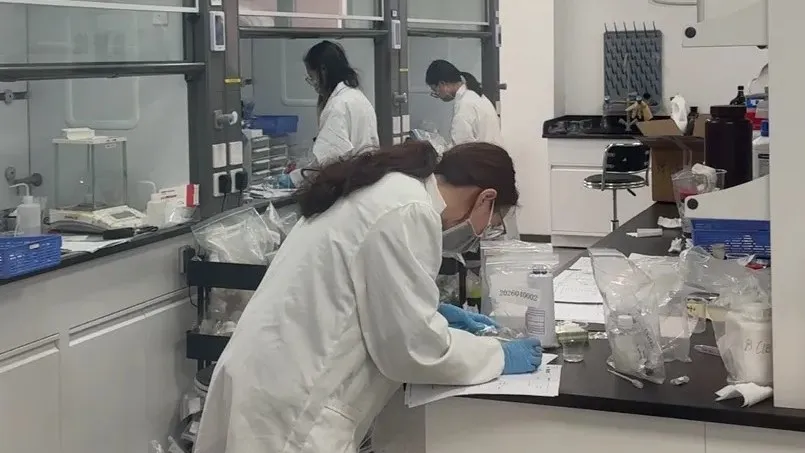
Impurity Analysis Services
Detect, identify and investigate unwanted material that may affect quality, performance or process consistency. Anysis supports trace elemental, organic, particulate and surface contamination questions.
What Is Impurity Analysis?
Impurity analysis focuses on unwanted or unexpected substances present in a raw material, process stream, component or finished product. The impurity may be a trace element, organic residue, particle, foreign material, processing chemical, corrosion product or surface contaminant.
Even a small amount of contamination can matter when it changes electrical, optical, mechanical, chemical or surface behavior. The challenge is therefore not only detecting an impurity, but understanding what it is, how much is present, where it is located and whether its distribution provides clues about the source.
Questions This Service Can Help Answer
- What is the unknown impurity, residue or particle?
- Is contamination localized on a surface, dispersed through the bulk or present at an interface?
- How much of a target element or compound is present?
- Does the impurity pattern suggest an incoming-material, process, cleaning or handling source?
Impurity & Contamination Analysis Capabilities
The exact workflow depends on the failed material and the evidence available. Investigations may focus on one failure mode or several interacting mechanisms.
Trace Elemental Impurities
Measure selected trace or ultra-trace elemental contaminants when suitable methods and matrices allow.
- Metals
- Purity evaluation
- Elemental survey
Organic Contaminants
Investigate solvents, oils, additives, residues and other unwanted organic species.
- Volatile organics
- Nonvolatile organics
- Process residues
Particles & Foreign Material
Identify localized particles, fibers, debris and unexpected solid contaminants.
- Particle chemistry
- Morphology
- Source comparison
Surface Contamination
Analyze thin contamination layers, residues and cleaning-related issues at the surface.
- Surface chemistry
- Residue mapping
- Cleaning evaluation
Process-Related Impurities
Compare samples across process steps to identify when contamination is introduced.
- Incoming material
- Process step
- Post-clean comparison
Material Purity
Characterize impurity profiles in high-purity or performance-sensitive materials.
- Trace survey
- Lot comparison
- Supplier qualification
Typical Impurity Analysis Techniques
The appropriate method depends strongly on contaminant class and detection level. Screening methods may be followed by more sensitive confirmation techniques.
Method selection is project-specific. Final technique, sample preparation and reporting scope should be confirmed before testing begins.
ICP-MS
Trace and ultra-trace elemental impurities
ICP-OES
Major/minor elemental impurities
GDMS
High-purity solid material analysis
LA-ICP-MS
Spatially resolved elemental information
IC
Ionic species in suitable matrices
GC-MS
Volatile/semi-volatile organic contaminants
LC-MS / HRMS
Nonvolatile organic impurities
FTIR / Raman
Residues, particles and organic identification
SEM-EDS
Particle morphology and localized elements
XPS
Surface contamination and chemical state
TOF-SIMS
Highly surface-sensitive molecular/elemental contamination
XRD
Crystalline impurity phases
Why Companies Investigate Impurities
The analytical scope should be tied to a real technical or business decision—not simply to a list of available instruments.
Supplier Qualification
Compare impurity profiles across suppliers, grades or incoming-material lots.
Process Troubleshooting
Determine whether contamination appears before, during or after a manufacturing step.
Cleaning Validation
Compare surface residues before and after cleaning or treatment.
Product Failure
Investigate particles or contaminants associated with adhesion, corrosion, electrical or performance issues.
Purity Control
Verify high-purity materials and monitor critical trace-element profiles.
Unknown Residue
Identify the chemical nature of a stain, deposit, haze, powder or foreign material.
What You May Receive
mpurity analysis deliverables focus on identifying unwanted substances, determining their level or location, and providing analytical evidence that can support contamination investigations.
Impurity Identification
Identification or classification of detected trace elements, organic contaminants, particles or other unwanted substances.
Concentration Results
Quantitative or semi-quantitative data showing impurity levels where suitable analytical methods are available.
Location & Distribution
Evidence showing whether contamination is associated with the bulk material, surface, particle, coating or interface.
Source Assessment
Technical interpretation that may help narrow potential materials, processes or environmental sources of contamination.
From Your Question to Useful Results
The process begins with the decision you need to make, then defines the analytical scope, sample plan and deliverables.
Define the Contamination Event
Document where the impurity appears, when it occurs and how the sample was handled.
Screen the Contaminant
Use broad elemental, molecular or microscopy screening to narrow the possibilities.
Confirm & Quantify
Apply targeted methods to confirm identity, concentration or surface location where required.
Compare & Interpret
Compare blanks, good/bad samples or process stages to look for evidence of a likely source.
Impurity Analysis FAQs
Clear answers about method selection, samples, project scope and analytical expectations.
Found an Unexpected Residue or Particle?
Share photos, sample history and where the contamination appears. We can help choose an appropriate screening strategy.
What is the difference between impurity analysis and material identification?
Impurity analysis focuses on unwanted substances and often includes concentration, distribution or source questions. Material identification focuses primarily on determining what an unknown sample is.
Can you measure trace and ultra-trace impurities?
Some techniques can reach trace or ultra-trace levels, but achievable detection depends on the analyte, matrix, preparation and method. Requirements should be discussed before testing.
Can you analyze a single small particle?
Localized microanalysis may be possible depending on particle size, location and composition. Submit photographs and dimensions if available.
Can you determine where contamination came from?
Analytical signatures can help compare possible sources, but source attribution is strongest when reference materials, process samples or good/bad comparisons are available.
Should I clean the sample before submission?
No, not if the contamination is the object of the investigation. Cleaning may remove critical evidence. Ask for handling instructions first.
Can you distinguish surface contamination from bulk impurities?
Yes, when the project uses techniques with appropriate information depths. Surface-sensitive and bulk techniques answer different questions.
Which techniques are commonly used?
Depending on the impurity, methods may include ICP-MS/OES, GDMS, IC, GC-MS, LC-MS/HRMS, FTIR, Raman, SEM-EDS, XPS, TOF-SIMS and XRD.
How should I package contamination samples?
Packaging should minimize cross-contamination and preserve the original condition. The best container depends on sample type and target analytes, so request submission guidance before shipping.